
Blog
India-US tariff crisis 2026: Supreme Court decision could reshape global trade and markets

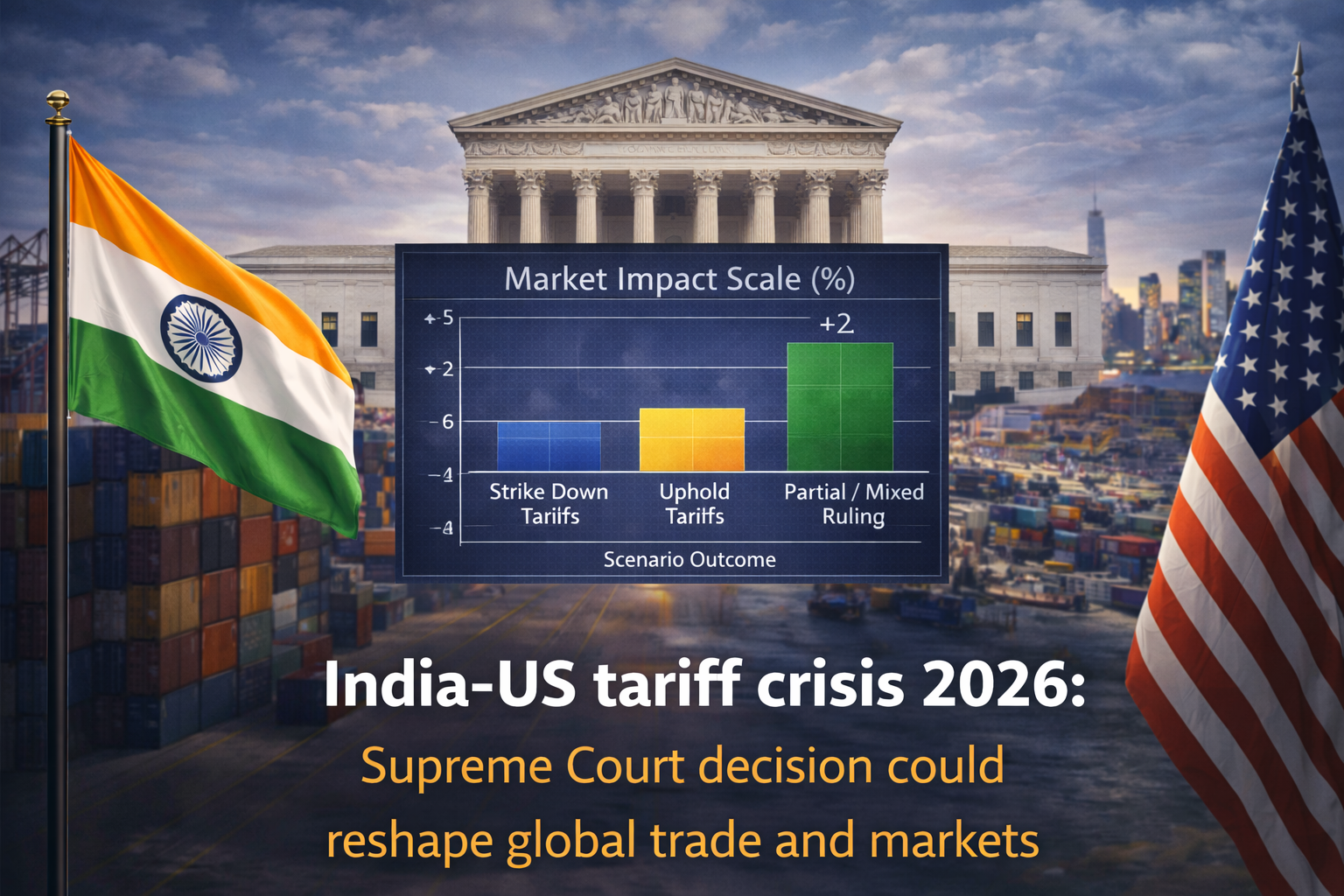
India-US tariff crisis 2026 has escalated into a major global trade and legal flashpoint as the U.S. Supreme Court prepares to rule on the legality of President Donald Trump’s sweeping tariff measures imposed under emergency powers. The tariffs — covering imports from nearly all U.S. trading partners — have already disrupted global supply chains and weighed on major markets, including India’s equity benchmarks. Analysts now warn that the Court’s decision could have profound implications for international trade policy, stock indices, export-oriented sectors, and diplomatic ties in 2026.
This article breaks down the legal challenge, the background of Trump’s tariff regime, the potential outcomes of the Supreme Court ruling, and how Indian markets, exporters, and global trade flows could be affected in the coming weeks.
The legal debate: Supreme Court reviews Trump’s tariff authority
At issue before the Supreme Court is whether President Trump exceeded his constitutional authority by using the International Emergency Economic Powers Act (IEEPA) to impose across-the-board tariffs on imports from most of the country’s trading partners. These tariffs stem from a series of executive actions that began in 2025 and were intended to address persistent U.S. trade deficits and other economic objectives.
Under IEEPA, a president can impose certain economic restrictions during national emergencies, but the statute does not explicitly grant the power to impose tariffs — a point central to constitutional challenges. Opponents argue that tariff imposition has historically been a legislative power reserved for Congress, not executive fiat.
Lower federal courts have already issued conflicting opinions, forcing the case up through appeals and ultimately to the Supreme Court, which heard oral arguments in November 2025. Early reports from the hearing indicated significant skepticism among some justices about the broad use of emergency powers for tariff imposition.
What Trump’s tariffs cover
Trump’s tariff regime — often referred to in media as “reciprocal” tariffs — includes:
-
A 10–50% baseline tariff on imports from most countries under the “Liberation Day” executive order issued in April 2025.
-
Additional targeted duties on specific partners and sectors, including retaliatory levies on China, Canada, Mexico, and others.
-
A newly announced 25% tariff on any country trading with Iran.
The cumulative effects have significantly increased the cost of imported goods in the U.S. and disrupted traditional trade relationships, especially those involving India and other emerging market economies.
Market reaction: uncertainty hits global equities
As anticipation built around the Supreme Court’s imminent ruling, markets have responded with heightened volatility. Over the week leading up to the expected decision, India’s major equity indices — the Sensex and Nifty 50 — experienced declines exceeding 2%, reflecting investor anxiety over trade policy uncertainty and its implications for corporate earnings.
Table: Indian market performance — tariff uncertainty impact
| Index | Approx. Change (5 sessions) | Notes |
|---|---|---|
| Sensex | -2.1% | Tariff and legal uncertainty pressure |
| Nifty 50 | -2.0% | Export-linked stocks underperform |
| Oil & Gas Sector | -2.8% | Impacted by Iran tariff and geopolitical risk |
| Foreign Fund Flows | -$900M | Outflows amid risk-off sentiment |
Source: Market data summaries and Reuters reporting on tariff announcements and risk sentiment.
Potential Supreme Court outcomes
The Supreme Court’s decision could broadly fall into one of several scenarios:
1. Strike down tariffs entirely
If the Court finds that the IEEPA does not authorize tariff imposition, it could invalidate most or all of Trump’s tariff measures. This outcome might lead to refund claims by importers and significant adjustments in trade policy going forward.
2. Partial ruling
The Court could narrow the scope of executive tariff authority without fully dismantling the entire regime, for example, limiting tariffs imposed via IEEPA but allowing other trade measures.
3. Uphold tariffs
A ruling in favor of Trump’s use of IEEPA would affirm executive authority, but likely maintain significant global trade frictions and uncertainty.
Each outcome carries distinct implications for global commerce, investor confidence, and bilateral trade negotiations.
Graph: Possible Supreme Court decision scenarios and market impact
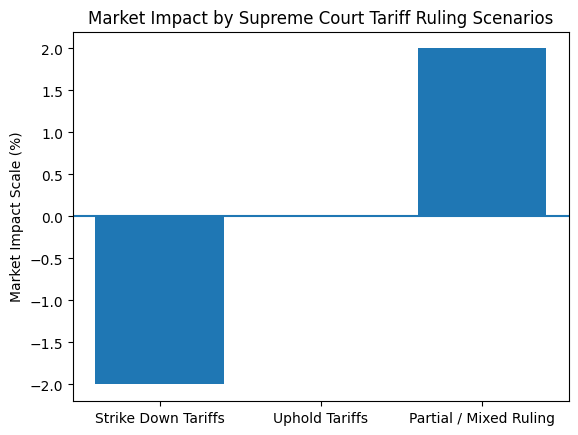
This conceptual graph illustrates relative optimistic (strike down tariffs) vs pessimistic (uphold tariffs) impacts on asset prices and trade sentiment.
What this means for India’s exporters
Indian exporters have been among the most affected by Trump’s tariff regime, with a 50% base tariff on many Indian exports to the United States and looming threats of further punitive levies, including proposed tariffs tied to Russia energy trade.
Should the Supreme Court strike down tariff authority, Indian export costs could fall, potentially improving competitiveness and opening up stronger commercial engagement with U.S. buyers. Conversely, maintaining or expanding tariffs could deepen the India-US tariff crisis 2026, complicating bilateral trade negotiations that are already in limbo.
Table: Export costs under different tariff regimes
| Scenario | Typical Tariff Cost | Export Competitiveness |
|---|---|---|
| Current 50% tariff | High | Reduced |
| Potential Supreme Court strike | ~0% | Enhanced |
| Full tariff upheld | ~50–100%+ | Severely Reduced |
Broader global trade implications
The Supreme Court’s decision will not just impact U.S.-India trade — it will influence global trade norms:
-
Tariff predictability: A ruling against executive tariff authority could restore greater predictability for global exporters.
-
Supply chain realignment: Stricter tariffs could accelerate regionalisation as companies seek alternative markets.
-
Geopolitical tensions: Tariffs tied to national emergency powers risk becoming tools of geopolitical leverage.
Analysts also warn that even if the Court upholds parts of the tariff program, Congress may still need to weigh in to avoid future legal challenges.
Currency and commodity markets
Uncertainty around trade policy and tariffs has also influenced commodity markets, particularly oil prices. Trump’s recent 25% tariff on countries trading with Iran contributed to a two-month high in oil prices as traders priced in geopolitical risk and supply constraints.
Gold and silver markets — traditional safe havens — have shown resilience as investors hedge against policy volatility, while currency markets have seen increased flows into the U.S. dollar amid risk aversion.
Diplomatic and strategic consequences
Beyond economics, the Supreme Court ruling intersects with broader strategic tensions:
-
U.S. trade policy under the Trump administration increasingly invokes emergency powers, blurring lines between trade and national security.
-
Several trading partners, including China and allies in Europe, have expressed concern about unpredictable tariff policy and retaliatory risk.
-
For India, the ruling will inform not only tariff strategy but diplomatic alignments, including potential recalibrations in engagement with multilateral partners.
Looking ahead: markets brace for verdict
As markets await the Supreme Court’s decision — expected imminently — investors are preparing for significant volatility. Some strategists believe a ruling against tariff authority could trigger sharp rallies in equity markets, especially in export-oriented sectors. Others warn that the broader India-US tariff crisis 2026 could persist even with legal relief, due to underlying geopolitical tensions and legislative responses that may follow.
Conclusion
India-US tariff crisis 2026 encapsulates a pivotal moment in global trade history, with legal, economic, and geopolitical forces entwined. The U.S. Supreme Court’s decision on Trump’s tariff authority will reverberate across global markets, shaping trade policy regimes, export competitiveness, investor sentiment, and diplomatic calculus in the months ahead.
For Indian exporters and global businesses alike, the outcome could redefine the trade landscape of 2026 and beyond, offering clarity and relief in one scenario — or continued turbulence in another.

