
Blog
EU-India critical minerals partnership gains momentum as trade talks accelerate amid global volatility

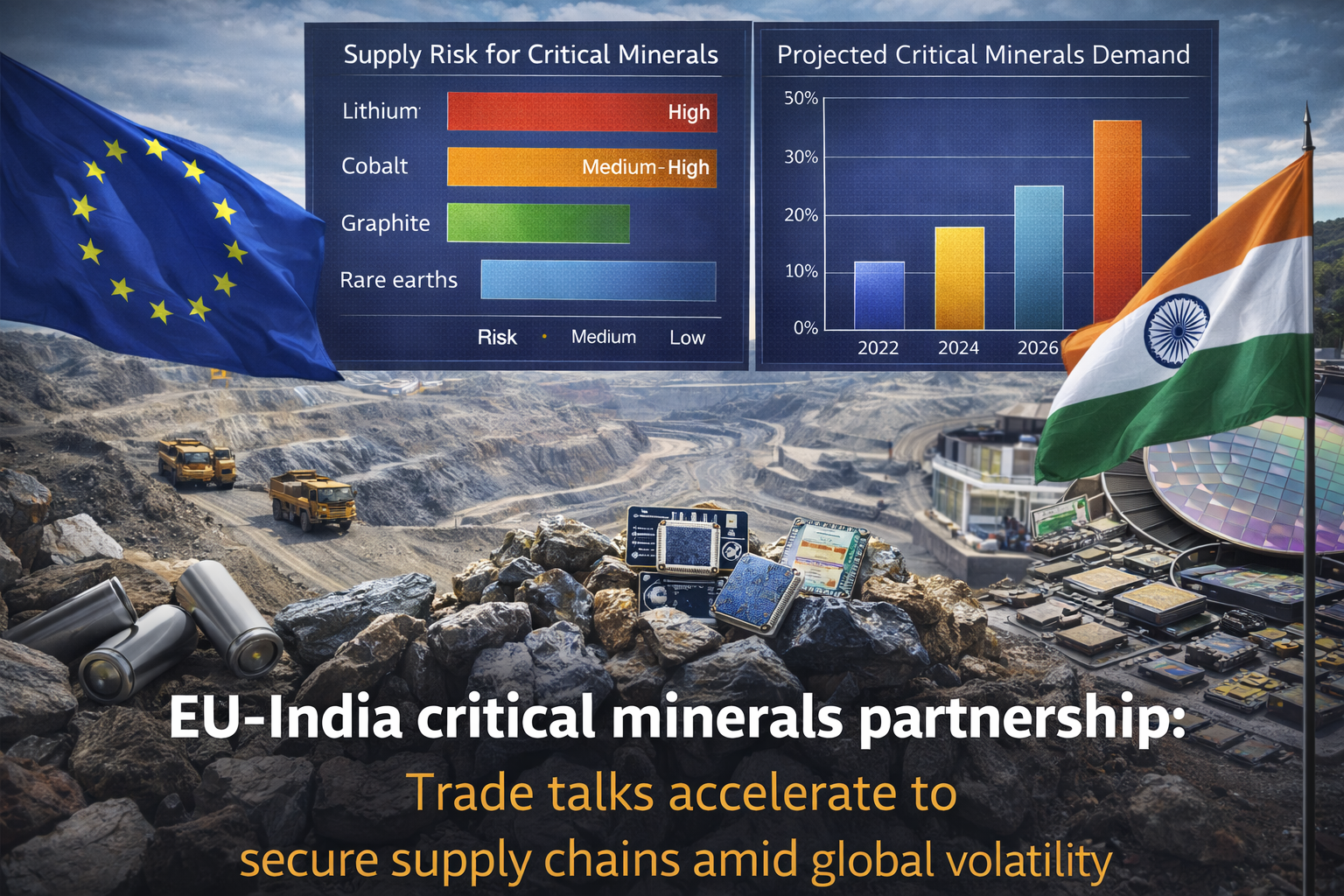
EU-India critical minerals partnership has emerged as a central pillar of India-European Union trade negotiations after senior officials from Brussels and New Delhi met on January 15 to fast-track a focused agreement covering semiconductors, rare earths, and strategically vital minerals. The move reflects a shared effort to reduce exposure to growing trade volatility emanating from the United States, tightening export controls, and geopolitical disruptions impacting global supply chains.
Rather than waiting for a comprehensive India-EU Free Trade Agreement (FTA), both sides are now prioritising a sector-specific deal aimed at ensuring long-term access to critical minerals essential for clean energy, digital infrastructure, defence manufacturing, and advanced electronics.
Why critical minerals have moved to the centre of EU-India trade talks
Critical minerals — including lithium, cobalt, nickel, graphite, and rare earth elements — are indispensable for modern economies. They power:
-
Electric vehicles and battery storage
-
Semiconductors and chip manufacturing
-
Renewable energy infrastructure
-
Defence and aerospace systems
-
Data centres and digital hardware
Over the past two years, supply concentration risks — particularly China’s dominance in processing and refining — have forced governments to rethink trade strategy. Both the EU and India see collaboration as essential to ensuring secure, diversified, and resilient supply chains.
Strategic timing: Hedging against U.S. trade volatility
The renewed push for the EU-India critical minerals partnership comes amid:
-
Escalating tariff uncertainty linked to U.S. election-year trade politics
-
Expanding U.S. export controls on advanced technologies
-
Sanctions-driven disruptions affecting energy and mineral flows
-
Legal challenges in the U.S. over tariff authority
European and Indian policymakers increasingly view bilateral cooperation as a hedge against unpredictable trade actions that could disrupt industrial planning in 2026 and beyond.
Key objectives of the EU-India critical minerals partnership
The proposed partnership is expected to focus on four main pillars:
1. Securing mineral supply chains
Both sides aim to reduce dependence on single-country suppliers by:
-
Jointly identifying alternative mining sources
-
Facilitating long-term offtake agreements
-
Coordinating stockpiling and reserve strategies
2. Semiconductor ecosystem cooperation
India’s ambitions to become a chip manufacturing hub align with Europe’s push to expand fabrication capacity. Cooperation may include:
-
Technology sharing frameworks
-
Investment protection mechanisms
-
Supply assurance for chip-grade minerals
3. Regulatory alignment and sustainability
The EU’s strict environmental and social governance rules require traceability and sustainability standards. India’s role would include:
-
Responsible mining practices
-
Certification and traceability systems
-
Compliance with EU Critical Raw Materials Act norms
4. Investment and financing channels
European companies are looking for stable investment environments, while India seeks capital inflows into mining, refining, and advanced manufacturing.
Table: Minerals likely to be covered under the partnership
| Mineral | Strategic Use | Global Supply Risk |
|---|---|---|
| Lithium | EV batteries, energy storage | High |
| Cobalt | Batteries, aerospace alloys | High |
| Nickel | Batteries, steel, EVs | Medium–High |
| Graphite | Anodes, semiconductors | High |
| Rare earths | Wind turbines, defence | Very High |
India’s position: From importer to strategic partner
India currently imports a substantial share of its critical minerals but is rapidly repositioning itself by:
-
Expanding overseas mining partnerships
-
Encouraging domestic exploration
-
Offering incentives for mineral processing and refining
-
Linking minerals policy with semiconductor manufacturing
For Europe, India offers a combination of geopolitical alignment, scale, and workforce capacity — factors critical for long-term trade resilience.
Europe’s motivation: Reducing strategic vulnerability
The European Union has openly acknowledged its dependence on concentrated supply chains for minerals and semiconductors. The EU-India critical minerals partnership complements European initiatives by:
-
Diversifying import origins
-
Strengthening ties with trusted partners
-
Supporting the EU’s green transition targets
-
Reducing exposure to export bans or trade coercion
Graph: Growing demand for critical minerals (text representation)
The chart highlights the accelerating demand trajectory driving urgency in trade negotiations.
Semiconductor angle: A quiet but crucial driver
While minerals dominate headlines, semiconductors are the silent engine behind the talks. India’s chip manufacturing roadmap requires:
-
Secure access to ultra-pure raw materials
-
Stable export channels for finished chips
-
Protection from sudden trade restrictions
The EU, meanwhile, is racing to expand its own chip capacity and views India as a complementary manufacturing and sourcing partner rather than a competitor.
How this differs from a traditional FTA
Unlike a full-scale free trade agreement, the proposed partnership is:
-
Narrowly focused
-
Faster to negotiate
-
Less politically contentious
-
Designed for execution, not symbolism
This “modular trade diplomacy” reflects a global shift where countries prioritise function-specific deals over all-encompassing agreements that take years to ratify.
Table: EU-India trade cooperation – old vs new model
| Feature | Traditional FTA | Sector-specific deal |
|---|---|---|
| Scope | Broad | Targeted |
| Time to conclude | Long (years) | Short (months) |
| Political resistance | High | Moderate |
| Strategic focus | Mixed | High |
| Execution risk | High | Lower |
Implications for global trade in 2026
The EU-India critical minerals partnership sends a strong signal to markets:
-
Trade alliances are becoming more strategic
-
Supply-chain security is now central to trade policy
-
Geopolitical risk management is shaping agreements
-
Emerging economies are being integrated into advanced supply chains
This trend is expected to intensify as countries prepare for further trade fragmentation in 2026.
Impact on businesses and investors
For companies, the partnership could mean:
-
Greater visibility on mineral supply
-
Reduced price volatility
-
New investment opportunities in India
-
Long-term supply contracts for European manufacturers
For investors, sectors likely to benefit include:
-
Mining and refining
-
Battery manufacturing
-
Semiconductor fabrication
-
Renewable energy infrastructure
Risks and challenges ahead
Despite optimism, challenges remain:
-
Environmental clearances and local opposition to mining
-
Infrastructure gaps in mineral processing
-
Regulatory coordination across jurisdictions
-
Competition from other mineral-rich partners
Balancing speed with sustainability will be critical to long-term success.
Outlook: What comes next
Negotiators are expected to:
-
Define an initial list of critical minerals
-
Establish working groups on semiconductors and supply chains
-
Set investment protection benchmarks
-
Announce a preliminary framework in 2026
If successful, the EU-India critical minerals partnership could become a template for future trade arrangements globally.
Conclusion
The EU-India critical minerals partnership marks a significant evolution in how major economies approach trade, moving away from tariff-centric debates toward strategic resilience and industrial security. As trade volatility increases and geopolitical fault lines harden, targeted cooperation on essential resources may define the next phase of global trade diplomacy.
For India and the European Union, the partnership offers not just economic value but strategic alignment — a shared response to an increasingly uncertain global trade environment.

