
Blog
EU Mercosur trade pact: European leaders push to seal deal as farmer backlash and safeguards dominate talks

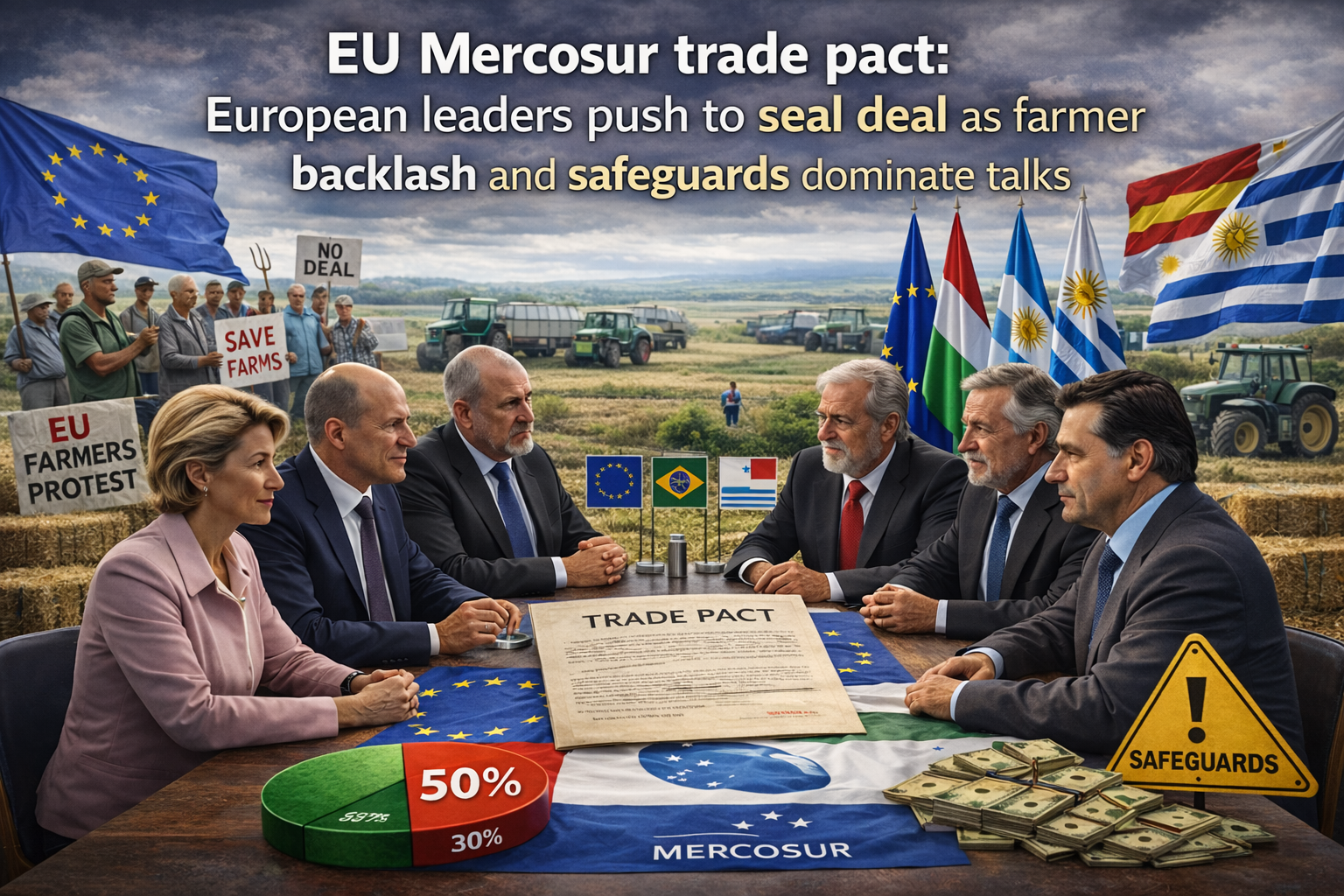
EU Mercosur trade pact momentum has picked up in the past 24 hours as European leaders and the European Commission intensify efforts to close one of the world’s largest pending trade agreements, while opposition from several member states remains anchored in farm-price fears and enforcement safeguards.
After more than two decades of negotiation, the agreement with Mercosur (Brazil, Argentina, Uruguay and Paraguay) is being framed by supporters as a strategic move to improve EU export access, reduce exposure to trade frictions elsewhere, and diversify sources of critical raw materials. Critics argue the pact could undercut EU farmers unless import controls, standards enforcement, and compensation mechanisms are credibly strengthened.
This article explains what changed, what the pact includes at a high level, why politics is still blocking it, and what businesses should watch next.
What happened in the last 24 hours
European officials and pro-deal governments have been working to “dispel doubts” and build a winning coalition inside the EU, with the Commission pushing for a timeline that could lead to a signing as soon as next week, according to Reuters reporting published January 7, 2026.
The same reporting highlights three major dynamics shaping the final stretch:
-
Support from key backers such as Germany and Spain
-
Continued resistance from countries including France, Poland and Hungary
-
A political push to add safeguards and accelerate financial support for EU farmers, referenced at around €45 billion in proposed support measures
Quick summary box: why this matters now
For readers who do not follow EU trade politics closely, the urgency is driven by timing and leverage:
-
The EU wants a large trade win that expands market access and signals reliability to partners.
-
Member-state politics, especially agriculture, can still derail the ratification path even if negotiators have “finished.”
-
Companies with EU–South America exposure are watching for changes in tariff schedules, quotas, rules of origin, and compliance requirements.
The political map inside Europe
Where the support is coming from
Supporters argue the agreement would deliver major tariff reductions and broaden EU export opportunities, particularly in manufacturing and services, while also strengthening access to South American supply chains and resources. Reuters notes Germany and Spain among those backing the final push.
Where the opposition remains strongest
Opposition is concentrated in countries where farm lobbies have significant political influence or where governments believe existing safeguards are insufficient. Reuters specifically points to France, Poland and Hungary as opponents, with concerns including cheaper agricultural imports such as beef and sugar impacting EU farmers.
A swing factor: conditional support
Reuters also notes shifts in tone from countries that were previously less supportive, including Italy appearing more favorable after proposals tied to farmer support, and Ireland signaling cautious optimism but emphasizing safeguards.
What the EU Mercosur trade pact is expected to do
While full legal texts and tariff-line detail matter most for implementation, the public framing is clear: the agreement would cut tariffs across a wide set of goods and deepen trade rules cooperation.
Likely headline impacts (conceptual)
-
Reduced tariffs on many EU exports into Mercosur markets
-
Greater market access for EU firms (industrial goods, autos, machinery, chemicals, potentially services)
-
Increased EU imports of agricultural products under specific terms and controls
-
Cooperation mechanisms on standards, sustainability commitments, and dispute processes
Supporters describe it as the EU’s largest deal in tariff-reduction terms, a point highlighted in Reuters coverage.
The biggest sticking point: agriculture
The political fight is largely about whether the EU can protect farmers from import surges and price pressure, while still offering meaningful access to Mercosur exporters.
Key farm-related concerns raised by opponents
-
Cheaper beef and sugar imports potentially undercutting EU producers
-
Enforcement doubts: whether production standards abroad match EU rules in practice
-
Fear of “one-way” pressure: farmers absorb costs while other sectors benefit
What proponents are offering to neutralize the backlash
Reuters reports the EU proposed accelerating roughly €45 billion in support for farmers, and officials have been meeting agriculture ministers to address pesticide limits and safeguards.
Table: supporters vs. opponents (based on latest reporting)
| Position inside EU | Countries mentioned in latest reporting | Main stated rationale |
|---|---|---|
| Support / pushing forward | Germany, Spain | Strategic trade expansion, tariff reductions, diversification |
| Opposed / resisting | France, Poland, Hungary | Protect farmers; fear import surges and unfair competition |
| Cautious / moving | Italy, Ireland | Support possible if safeguards and farmer protections are strong |
Simple graphs: why the last mile is hard
Graph 1: EU ratification risk (conceptual)
This is not a numeric forecast—just a simple way to visualize the bottleneck.
The pact can be “ready” on paper while still failing at political checkpoints.
Graph 2: distribution of perceived winners and losers (conceptual)
This mismatch is why safeguard design and compensation packages are central.
Why the EU is pushing now: strategy, not just trade
The Commission’s push is not happening in a vacuum. Reuters notes that supporters see the deal as helpful for exports affected by U.S. import taxes and for reducing dependency on China by improving access to critical minerals.
That frames the pact as a hedge against:
-
External tariff shocks (especially where EU exporters face headwinds)
-
Concentrated supply risks (critical minerals and strategic inputs)
-
A more fragmented global trade environment
What businesses should watch in the next week
Even if the political push succeeds, companies will need details. Here are the practical items trade teams should track immediately:
1) Tariff schedules and phase-out periods
-
Which product lines get immediate reductions vs. multi-year phase-outs
-
Whether sensitive categories are quota-limited
2) Rules of origin and compliance documentation
-
How “origin” is defined for complex manufactured goods
-
Documentation requirements that could raise administrative cost
3) Agricultural safeguard mechanisms
-
Trigger thresholds for import surges
-
Enforcement protocols for standards (including pesticides and sanitary rules)
4) Political calendar risk
Reuters notes that even with member-state approval, the deal still must pass a vote in the European Parliament, where opposition (especially from France’s political and farm constituencies) can remain influential.
Table: operational checklist for exporters and importers
| Business type | Immediate action | Why it matters |
|---|---|---|
| EU industrial exporters | Map SKUs to likely tariff lines and model margin upside | Captures early advantage if phase-outs are front-loaded |
| EU food producers | Scenario plan for price pressure and safeguard triggers | Prepares for volatility if imports rise |
| Mercosur exporters | Prepare origin proof and compliance for EU standards | Reduces border delays and rejection risk |
| Logistics providers | Plan capacity and routing for potential demand shifts | Trade deals often re-route flows quickly |
Outlook: what happens next
Reuters reporting suggests a possible signing as early as next week, but the path remains politically sensitive, with member states and farmer concerns still in play.
What to expect in the near term:
-
More public messaging focused on safeguards, enforcement, and farmer support
-
Attempts to isolate the agreement from domestic political fights by emphasizing strategic benefits
-
Continued lobbying by farm groups and environmental stakeholders
-
A ratification debate that may hinge on “how enforceable” the protections are, not just what is promised

