
Blog
India global trade strategy 2026: New markets, FTAs and the US trade deal stalemate

India global trade strategy 2026 has taken on new urgency as New Delhi confronts the extended limbo in its long-awaited trade deal with the United States and accelerated efforts to secure alternative markets for Indian exporters. With US tariffs still high and negotiations unresolved, India is simultaneously pursuing a range of free trade agreements and export diversification strategies to sustain export growth and strengthen global commercial ties.
This article explains why the India–US trade deal is stalled, how India is responding, what new markets and trade partnerships are emerging, and what this means for India’s export sectors and global trade position in 2026.
Why the India-US trade deal remains in limbo
Trade negotiations between India and the United States, initiated to reduce tariffs and expand bilateral commerce, have faced delays into 2026 despite years of discussions. Key issues include tariff barriers, market access demands, and diplomatic trust dynamics.
U.S. Commerce Secretary Howard Lutnick noted that the deal was “nearly finalized” but stalled because of certain diplomatic expectations around direct leader engagement. India refrained from making the final political outreach at the time, contributing to stalled progress.
New Delhi, meanwhile, has rejected assertions that any single leader’s actions are responsible for the impasse, underscoring ongoing dialogue and cooperation efforts.
Historical context of trade frictions
-
US Tariff escalations: In 2025, U.S. imposed tariffs of up to 50% on Indian goods as part of broader trade and geopolitical policy.
-
Diplomatic friction: Trade discussions struggled over tariffs, agricultural access, and energy policy differences.
-
Extended negotiations: Despite multiple rounds of talks, substantive issues like tariff structure and market openness remain unresolved.
Impact on Indian exports: tariff challenges
High tariffs from the United States, India’s largest export destination, have already taken a toll on order volumes, especially in labour-intensive sectors. Exporters faced punitive duties starting mid-2025, prompting immediate strategic adjustments.
Sector exposure to U.S. tariffs (2025)
| Sector | Export Value to US (2025 est.) | Level of Impact |
|---|---|---|
| Textiles & Apparel | ~$18 billion | High |
| Leather & Footwear | ~$6 billion | High |
| Gems & Jewellery | ~$5 billion | Medium |
| Engineering Goods | ~$12 billion | Moderate |
| Pharmaceuticals & Chemicals | ~$10 billion | Moderate |
Estimates based on export performance and tariff exposure.
Diversifying into new markets: India’s strategic push
Amid the trade deal uncertainty, India is actively seeking alternative markets and trade agreements to mitigate tariff risks and maintain export growth.
Alternative markets initiative
India is engaging with approximately 40 countries to explore expanded market access, especially for textiles and labour-intensive products where tariffs have hit margins hardest.
Government-led trade missions and export councils are mapping potential demand hubs in:
-
Middle East
-
Latin America
-
Central Asia
-
Southeast Asia
-
African markets
These diversification efforts aim to reduce dependency on any single export destination and align with global trade shifts.
Free Trade Agreements shaping India’s export outlook
In addition to market diversification, India is reinforcing its position through free trade agreements (FTAs) that offer preferential access and reduced tariffs.
Key FTAs and trade pacts
| FTA / Trade Agreement | Status | Key Benefits |
|---|---|---|
| India–EFTA TEPA | Entered into force Oct 2025 | Reduced tariffs on ~99% of Indian exports to EFTA; investment inflows expected; streamlined customs procedures. |
| India–UK Trade Agreement | Signed Jul 2025 | Enhanced market access for Indian goods, investment boost, tariff reductions. |
| India-EU FTA | In negotiation | Potential access to Europe’s large market with safeguard terms. |
| India-New Zealand FTA | Operational | Broader visa access, investment commitments, services market expansion. |
These trade engagement efforts are central to India’s strategy to reduce tariff and market access friction created by the stalled India–US deal.
Export performance trends in 2026
Despite tariff challenges in the U.S., India’s overall merchandise exports have shown resilience, marking continued growth in diversified markets.
Graph: Export destination growth (2023–2026)
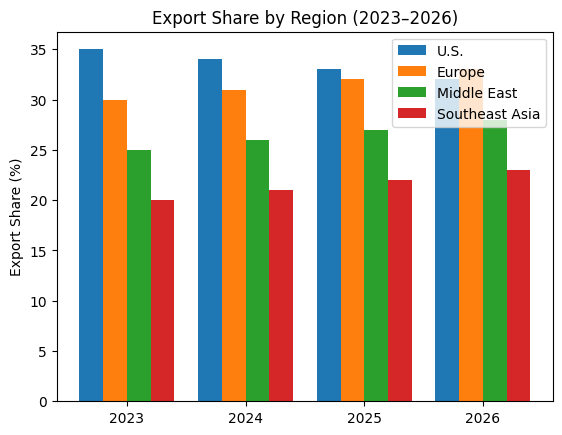
This conceptual graph suggests a relative shift away from concentrated dependence on the U.S. as Europe, Middle East, and Southeast Asia capture larger export shares.
Government and policy actions
Trade missions and diplomacy
India’s commerce ministry and trade representatives have increased diplomatic outreach to strengthen trade relationships, counterbalancing the lack of a firm bilateral deal with the United States.
Notably:
-
Trade missions to ASEAN and Middle East markets to attract inbound buyers
-
Participation in critical minerals meet with the United States and partners ahead of AI and supply chain summits — signalling engagement beyond tariff disputes.
-
EU FTA talks advancing toward final drafts and fewer sticking issues.
These actions aim to maintain India’s trade competitiveness and address export headwinds.
How exporters are adapting
In response to stalled trade deal negotiations and tariff pressures, Indian exporters are realigning strategies:
Operational adjustments
-
Diversifying export destinations beyond the U.S.
-
Entering joint-ventures or subsidiaries in target markets to bypass trade barriers
-
Altering product portfolios to better fit demand in tariff-friendly regions
Industry associations have reported that some sectors are exploring distribution hubs in the Middle East and Africa to reduce freight costs and tariff pressure.
Potential risks and challenges ahead
While diversification and FTAs cushion some impacts, several risks persist:
-
Tariff uncertainty in major markets (including the United States) could still dampen export orders.
-
Slow progress in negotiations may continue to deter U.S. buyers’ confidence.
-
Domestic inflation and cost pressures may increase production costs and reduce competitiveness if not mitigated.
Policymakers must balance diplomatic engagement with structural reforms to sustain export momentum.
Table: Strategic priorities for Indian trade policy
| Priority | Action |
|---|---|
| Market diversification | Expand into Middle East, Latin America, Africa |
| FTA conclusion | Fast-track EU, deepen UK and EFTA market access |
| Tariff mitigation | Protect exporters with diplomacy, incentives |
| Supply chain resilience | Integrate with global value chains (AI, tech, critical minerals) |
| Trade facilitation | Improve logistics, customs reforms |
These priorities reflect a multi-pronged approach to navigating a complex global trade environment in 2026.
Conclusion: India’s evolving role in global trade
Global trade in 2026 and India’s role is defined by both challenge and opportunity. While the India–US trade deal remains in limbo, high tariffs and stalled negotiations have compelled India to embrace market diversification, deepen free trade engagements, and bolster export competitiveness.
India’s broader strategy — anchored in FTAs, diplomatic outreach, and operational adaptation — seeks to cement its global trade position and reduce overdependence on any single market. The coming months, particularly progress in EU and other FTAs, will be critical in shaping India’s export trajectory and its integration into shifting global trade networks.

