
Blog
India-Iran trade under shadow: 25% US tariffs on countries trading with Iran hit India’s exports

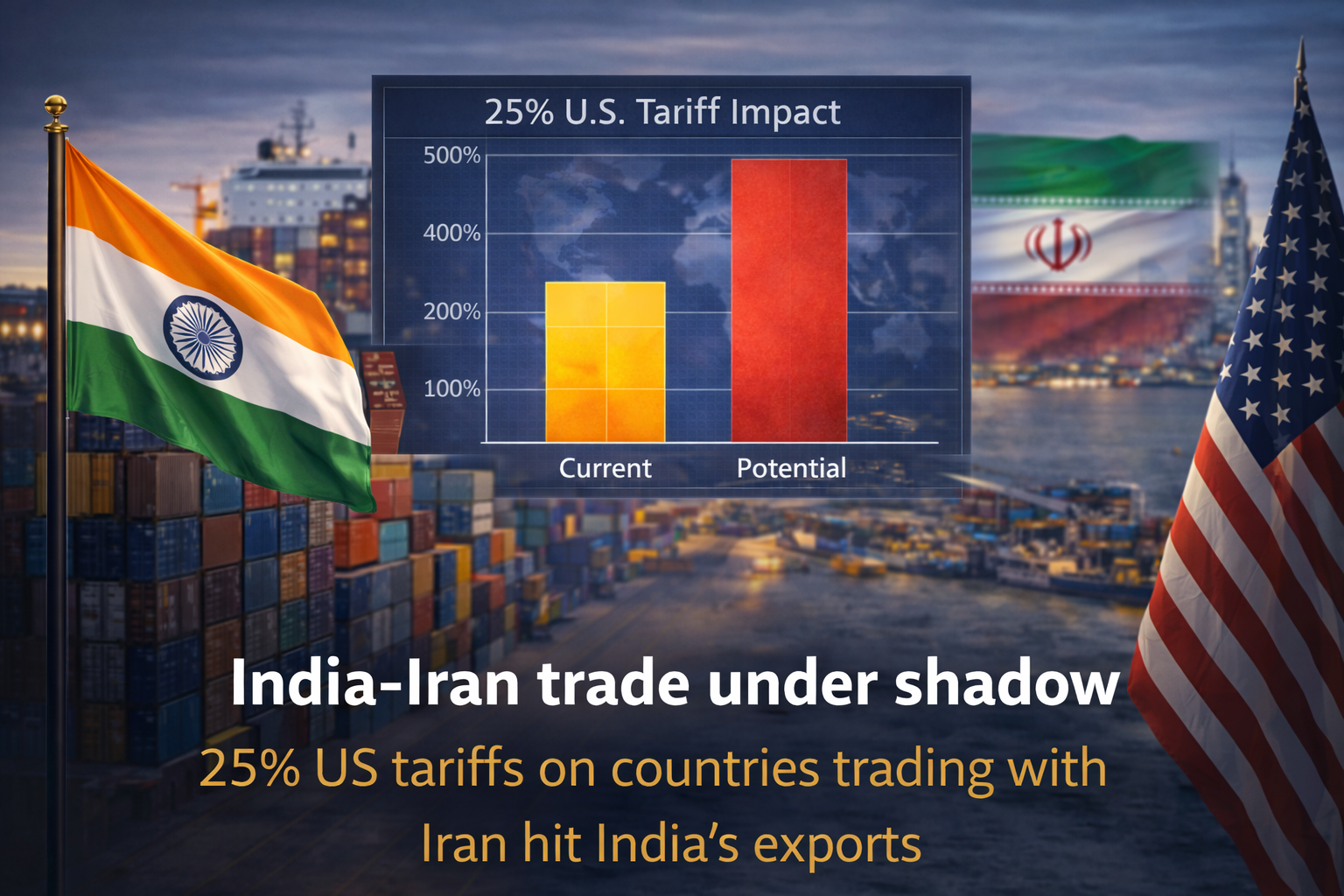
India-Iran trade under shadow as U.S. President Donald Trump on January 12, 2026 imposed a 25% tariff on all countries that conduct trade with Iran, in a move aimed at economically isolating Tehran amid escalating domestic protests and diplomatic tensions. The sweeping tariff order — announced via social media and described as “final and conclusive” — is designed to penalize any nation doing business with Iran, a country with which India has longstanding commercial ties.
While the broader geopolitical context involves significant unrest in Iran and continued pressure by the United States on Tehran over human rights and political governance, the new trade policy could have far-reaching consequences for Indian exporters, energy importers, and economic planners who have structured trade relationships that include Iran.
This article breaks down the tariff decision, examines its implications for Indian trade — including different sectors — and outlines broader economic, strategic, and diplomatic outcomes for India in 2026.
What the new tariff means
On January 12, 2026, President Trump declared that any country engaging in business with Iran — including trade in goods, resources, or services — would face a 25% tariff on trade with the United States, effective immediately.
Key features of the tariff announcement:
-
25% tariff on nations doing business with Iran, including significant trading partners such as India, China, and Gulf states.
-
The tariff is declared as “final and conclusive” by the U.S. administration, though legal details and codification remain ambiguous.
-
The measure builds on previous tariff actions, including earlier levies linked to unrelated disputes (such as those over Russia).
Though the announcement was made without detailed legal documentation or policy framework, it signals an aggressive use of trade policy as a geopolitical instrument.
Historical context: India’s trade ties with Iran
India and Iran have maintained an economic relationship that spans several decades. Key aspects include:
-
Bilateral trade volume, valued at USD 1.68 billion in 2024–25, with India exporting goods worth approximately USD 1.24 billion to Iran and importing USD 0.44 billion.
-
Energy imports: While India’s direct crude oil imports from Iran have diminished since sanctions re-imposition in 2019, Tehran remains economically significant in broader regional trade.
-
Strategic infrastructure projects, most notably the Chabahar Port development, which serves as an important logistics and transit hub connecting India to Afghanistan and Central Asia.
The new tariff places these longstanding relationships in a precarious position, especially as it comes on top of existing trade and tariff tensions involving the United States.
Visual snapshot: India–Iran trade composition (2024–25)
| Component | Value (USD) | Notes |
|---|---|---|
| India → Iran exports | 1.24 billion | Major export destinations include basmati rice, tea, sugar, pharmaceuticals |
| India ← Iran imports | 0.44 billion | Export includes dry fruits, chemicals, glassware |
| Total bilateral trade | 1.68 billion | Approximately |
| Export share to US from India | ~41% | US remains India’s top export destination while Iran is not in top 5 |
Immediate effects on Indian exports
The new tariff adds a layer of complexity to India’s exporters, especially those with Iran-linked trade flows or indirect exposure through regional supply chains and distribution networks.
Sectoral exposure
-
Basmati rice: Iran has traditionally been one of the largest buyers of Indian basmati rice, often purchasing close to 1.2 million tonnes annually.
-
Chemicals and dry goods: Organic and inorganic chemical imports from Iran formed part of energy-linked and input markets in India.
-
Pharmaceuticals and textiles: Both sectors have export footprints in the Middle East and may face indirect cost pressures depending on tariff application to regional market flows.
Graph: Potential tariff impact on Indian exports
Note: This graph represents a conceptual estimate of export risk by percentage relative to a baseline scenario without the Iran-linked tariff.
Dual tariff tensions: Russia, Iran, and India
This new tariff on Iran ties into broader U.S. strategies that have already affected India:
-
In 2025, India faced high tariffs from the United States — including a cumulative 50% tariff linked to trade disagreements and penalties associated with Russian energy purchases.
-
Earlier, concerns surfaced about a U.S. bill proposing tariffs of up to 500% on nations continuing to buy certain sanctioned energy as part of counter-Russia measures — a measure that would dwarf the new Iran-linked tariffs.
India now finds itself amid overlapping tariff risks related to multiple geopolitical flashpoints.
Diplomatic tension vs economic pragmatism
The tariff announcement comes at a time when India is trying to balance its diplomatic and economic interests:
-
Strategic autonomy: India has emphasised that trade and energy policy decisions are based on national imperatives and long-term economic planning.
-
US engagement: Despite tariff disagreements, India remains a strategic partner of the U.S. in areas such as security cooperation, critical minerals, and technology.
-
Global trade diversification: India has signed several free trade agreements and is pursuing others to offset risks associated with tariff exposure in any one direction.
This balancing act underscores the broader strategic calculus shaping India’s foreign economic policy in 2026.
Impact on Indian commodity exporters
Basmati rice: case in point
Indian basmati rice exporters like LT Foods, KRBL, and Chaman Lal Setia Exports are already under market scrutiny as the new tariff impacts trade confidence and share prices.
Chemicals and dry fruits
Although smaller in relative value, imports and exports in these categories have been part of India–Iran trade. Any tariff spillover could affect pricing and logistics arrangements.
Table: Exporter risk profile (post-tariff)
| Export Sector | Iran Exposure | US Market Exposure | Overall Risk |
|---|---|---|---|
| Basmati rice | High | High | Elevated |
| Tea & spices | Moderate | Moderate | Medium |
| Chemicals | Low | Moderate | Medium |
| Textiles | Low | High | Medium |
| Pharma | Low | Low | Low |
Potential responses by India
India’s policymakers and trade bodies may undertake measures such as:
-
Trade negotiation acceleration with partners such as the EU and EFTA to secure tariff reliefs and preferential access.
-
Export stimulus and sector-specific support to cushion immediate tariff shocks.
-
Supply chain diversification to reduce reliance on markets most affected by U.S. tariffs.
These policy responses could help Indian exporters navigate an increasingly fragmented trade environment.
Broader global trade implications
The 25% tariff on Iran trade partners highlights a trend in which geopolitical tensions intersect with trade policy:
-
Tariff instruments are being used beyond traditional trade disputes, extending into foreign policy and human rights pressures.
-
Countries with overlapping trade partnerships that include sanctioned states may face compounded tariff exposure.
-
Global supply chains could realign toward blocs less affected by such punitive tariffs.
Conclusion
India-Iran trade under shadow reflects how evolving U.S. tariff policy — aimed at pressuring Iran over internal unrest — is reshaping trade dynamics for third countries, especially India. With India’s export sectors already navigating a complex tariff landscape and pursuing diversification through free trade agreements and new market linkages, the latest tariff directive adds urgency to policy recalibration.
Indian industries, from basmati rice producers to chemical exporters, may see near-term disruption, while policymakers balance economic interests with strategic diplomacy. As global tariffs increasingly reflect geopolitical priorities, India’s trade in 2026 will likely be marked by adaptation, diversification, and negotiation on multiple fronts.

