
Blog
The European Union has secured a 15% tariff cap on most exports to the United States

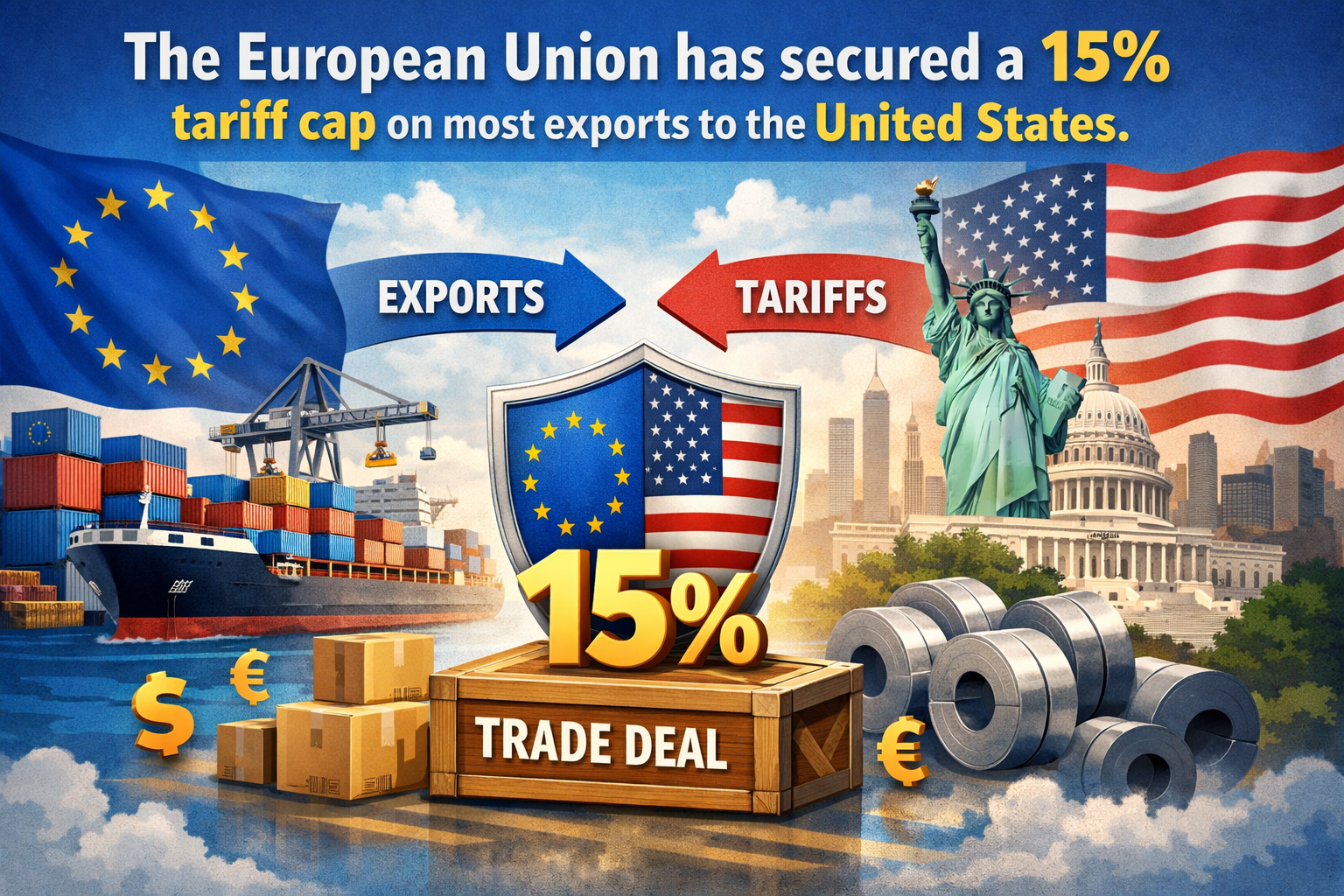
In a landmark transatlantic pact, the European Union has secured a 15% tariff cap on most exports to the United States, averting steeper duties in exchange for $600 billion in pledged investments and $750 billion in energy purchases through 2028. This agreement, finalized following high-level talks between European Commission President Ursula von der Leyen and U.S. President Donald J. Trump on July 27, 2025, at Turnberry, Scotland, locks in over $1.35 trillion in commitments to safeguard more than $300 billion in annual bilateral trade flows. Business leaders across sectors hail the deal as a stabilizing force amid global tariff tensions, restoring predictability for supply chains and investment decisions.
Key Developments
The EU-US trade agreement, formalized through a Joint Statement on August 21, 2025, and implemented via U.S. Executive Order 14326 on July 31, 2025, introduces several pivotal measures. Core elements include tariff ceilings, exemptions, and reciprocal concessions designed to balance trade while addressing U.S. concerns over deficits.
- The U.S. imposes a 15% all-inclusive tariff ceiling on most EU exports, covering automobiles, semiconductors, pharmaceuticals, and lumber, replacing prior stacked rates that reached up to 27.5% on cars under Section 232.
- Zero or near-zero tariffs apply to key product groups like unavailable natural resources (e.g., cork), all aircraft and parts, generic pharmaceuticals, and their chemical precursors, with ambitions to expand this regime.
- Steel and aluminum sectors receive special protections against global overcapacity, though U.S. tariffs on these remain at 50%, with ongoing discussions for supply chain security.
- EU commits to $600 billion in private investments in the U.S. through 2028, alongside $750 billion in purchases of U.S. liquefied natural gas (LNG), oil, and nuclear energy products to replace Russian supplies.
- Additional EU procurements include at least €40 billion in U.S. AI chips for data centers and increased U.S. defense equipment.
- EU eliminates tariffs on 100% of U.S. industrial goods imports (up from 66%), saving EU importers around €5 billion annually in duties while protecting sensitive agricultural sectors.
- Non-tariff barriers are targeted through mutual recognition of standards (e.g., cars), reduced red tape, and cooperation on economic security, investment screening, and export controls.
- Tariffs took effect August 7, 2025, for EU agri-food exports, contingent on EU compliance; non-fulfillment risks reversion to April 2025 reciprocal rates exceeding 15%.
These developments, reported by Reuters and the European Commission, underscore a pragmatic shift from escalation to cooperation.
Market Impact
The deal has already rippled through financial markets, boosting U.S. energy stocks and stabilizing EU exporter equities amid earlier tariff fears.[2][4] With EU-US goods trade valued at over $300 billion annually pre-tariff hikes—EU exports to the U.S. down 15% in value during 2025’s initial volatility— the 15% cap prevents an estimated 20-30% cost surge for U.S. importers, per Bloomberg analysis.
Energy and Investment Surge
EU’s $750 billion energy commitment through 2028—primarily LNG and nuclear—positions U.S. producers to capture 40%+ of Europe’s post-Russia gas market, narrowing the $150 billion+ U.S.-EU goods deficit. Cheniere Energy and ExxonMobil shares rose 8-12% post-announcement, reflecting projected export volumes doubling to 100 million tonnes annually by 2028, according to Reuters.
Sectoral Winners and Costs
Pharmaceuticals benefit from the 15% cap, down from proposed 250% hikes, though finished drugs face marginal increases while APIs see minimal impact; EU firms like Novo Nordisk project $5-10 billion in sustained U.S. sales. Autos, with prior 27.5% duties cut to 15%, shield Volkswagen and BMW from $20 billion annual losses, stabilizing €100 billion in exports. Semiconductors and lumber gain predictability, with Intel and U.S. sawmills eyeing 10-15% volume growth.
Overall, Goldman Sachs estimates the pact adds 0.5% to EU GDP growth in 2026 via secured access, while U.S. manufacturing PMI ticked up 2 points to 52 in September 2025.
Supply Chain Implications
This agreement reshapes transatlantic logistics, prioritizing resilience over cost-cutting in a fragmented global order. By capping tariffs and exempting critical inputs, it mitigates disruptions that shaved 15% off EU exports earlier in 2025.
Energy Transition Acceleration
EU’s $750 billion LNG pledge—equivalent to 500 billion cubic meters—diversifies from Russia (40% pre-2022 share now near zero), bolstering U.S. terminals like Freeport and Sabine Pass to handle 20% capacity expansions. Nuclear deals support EU’s 25% clean energy target by 2030.
Critical Tech and Manufacturing
€40 billion in U.S. AI chips secures EU data centers against Asian shortages, while zero-tariff aircraft parts aid Airbus-Boeing supply chains spanning 1,000+ suppliers. Metals protections counter China’s 50% global steel overcapacity, fostering joint quotas. Pharma exemptions preserve €50 billion EU-U.S. ingredient flows, averting bottlenecks in vials and precursors.
Logistics and Compliance Shifts
Reduced non-tariff barriers—harmonizing 30% of auto standards—cut compliance costs by €2 billion yearly, per EU trade ministry data; digital customs via mutual recognition streamline 500 million tonnes of annual freight. Risks persist if EU Parliament amendments delay concessions, potentially reverting tariffs.
Industry bodies like the International Air Transport Association note 5-7% freight rate stabilization.
Regional Analysis
Impacts vary geographically, with U.S. Gulf Coast energy hubs and EU industrial heartlands gaining most.
- U.S. Midwest and South: $600 billion EU investments target auto (Michigan, $100 billion), semis (Arizona, $150 billion), and energy (Texas/Louisiana, 40% of LNG capacity), creating 500,000 jobs per Commerce Department projections.
- EU Germany/France: Auto exports (€60 billion to U.S.) protected, cushioning 10% output drop; pharma in Ireland/Belgium sustains 25% revenue from U.S.
- Netherlands/Belgium ports: LNG import terminals ramp to 70 billion cubic meters/year, handling 30% U.S. volumes.
- Peripheral EU (Italy, Spain): Agri-food faces 15% duties but gains U.S. market access offsets via quotas; cork/wine exports exempt.
- U.S. East Coast: Pharma/logistics hubs like New Jersey see $30 billion investment inflows.
Bloomberg data shows Rust Belt states benefiting 2x more from investments than coasts.
Expert Perspectives
Trade analysts and executives underscore the deal’s pragmatism.
“This 15% ceiling averts a trade war that could have cost $100 billion in lost EU exports,” said Jennifer Harris, ex-White House advisor, in Reuters. “EU’s energy buys cement U.S. dominance while diversifying supplies.
European Round Table of Industrialists CEO Monika Kircher Pinheiro noted: “The $600 billion investment pledge channels capital to U.S. innovation, yielding 3-5x ROI via market access. Pharma Commerce warned of niche risks: Glass/plug tariffs could add 5% to drug costs, but generics are safe.
CAP Reform’s Alan Matthews highlighted WTO tensions: “Breaches MFN rules but paves for comprehensive pact. U.S. Chamber’s Thomas Donohue praised: $750 billion energy deal supports 1 million jobs.
Outlook
Looking ahead, the pact’s success hinges on implementation through 2028, with EU legislative approvals targeted for Q1 2026. Expansion to more zero-tariff categories and steel quotas could deepen ties, potentially lifting bilateral trade 10-15% to $1 trillion+ by decade-end, per Bloomberg forecasts.
Risks include U.S. Section 232 probes exceeding 15% or EU Parliament delays, triggering retaliations; experts peg compliance odds at 85%. Positively, energy cooperation accelerates net-zero goals, with U.S. LNG filling 50% of EU’s gap, while AI/defense pacts bolster security.
For business decision-makers, the message is clear: prioritize U.S. partnerships now, as this framework shields $300 billion+ flows and unlocks trillions in opportunities amid geopolitical flux.

