
Blog
US Vietnam tariff deal: How Vietnam Cut US Tariffs from 46% to 20% and Secured Zero-Tariff Market Access

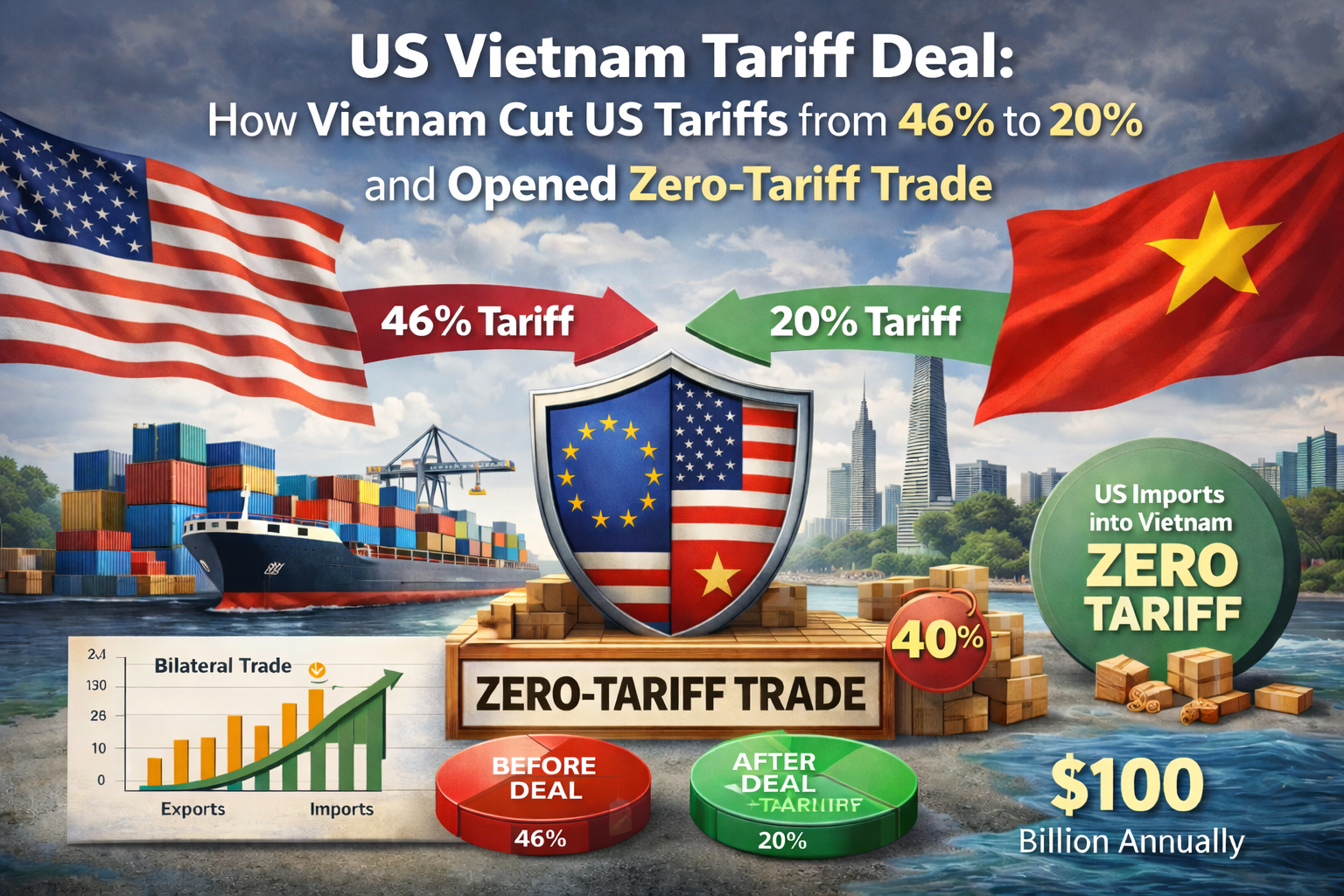
The US Vietnam tariff deal marks a pivotal moment in bilateral trade relations, averting a potential trade conflict while reshaping supply-chain dynamics across Southeast Asia. After months of negotiations, the United States agreed to reduce threatened tariffs on Vietnamese exports from 46% to a baseline rate of 20%. In return, Vietnam committed to eliminating tariffs on nearly all American goods and strengthening enforcement measures to prevent transshipment and duty evasion.
Finalized in late 2025, the framework reflects Washington’s push for reciprocal trade and tighter supply-chain controls, while allowing Vietnam to maintain its export-led growth model and its rising role as a manufacturing hub serving US markets.
Overview of the US Vietnam tariff deal
At its core, the US Vietnam tariff deal establishes a reciprocal trade structure based on three central pillars:
-
Reduced tariffs on locally produced Vietnamese exports to the United States
-
Zero-tariff access for most US goods entering Vietnam
-
Strong enforcement against transshipment and misclassification of goods
This balance allows both countries to expand trade while addressing long-standing US concerns about supply-chain diversion from third countries.
Key developments and timeline
The agreement followed a period of heightened trade uncertainty in 2025, when the United States announced sweeping reciprocal tariff plans.
Key milestones include:
-
Early 2025: The US signals potential tariffs of up to 46% on Vietnamese exports
-
Mid-2025: A temporary suspension allows bilateral negotiations to begin
-
Late 2025: Framework agreement is finalized
-
Early 2026 (expected): Full legal implementation and enforcement
Tariff structure explained
The new tariff system distinguishes clearly between locally manufactured goods and transshipped products.
Tariff comparison table
| Category | Before negotiations | After US Vietnam tariff deal |
|---|---|---|
| US tariff on Vietnamese exports | Up to 46% | 20% baseline |
| Tariff on transshipped goods | Unclear enforcement | 40% penalty |
| Vietnam tariff on US goods | Varied duties | Zero on most goods |
| Non-tariff barriers | High and restrictive | Significantly reduced |
Visual explanation: tariff reduction impact
Graph 1: US tariff levels on Vietnamese exports
Before deal: 46% | ██████████████████████████
After deal: 20% | ██████████
This reduction represents a decline of more than half in the originally proposed tariff burden, providing exporters with cost stability and preserving Vietnam’s competitiveness in the US market.
Market impact on Vietnam’s economy
Lower tariffs deliver immediate relief to Vietnam’s export-oriented economy. Key sectors such as electronics, garments, footwear, and furniture avoided sharp cost increases that would have weakened demand in their largest export market.
Key economic effects:
-
Stabilization of export pricing and order volumes
-
Reduced risk of factory shutdowns or relocation
-
Improved investor confidence in Vietnam’s manufacturing sector
-
Continued inflows of foreign direct investment
Vietnam’s economy, which maintained strong growth momentum in 2025, benefits from the avoidance of a sudden export shock while strengthening its compliance credentials.
Market impact on US exporters
Vietnam’s commitment to near-zero tariffs on American goods opens meaningful opportunities for US companies across several sectors.
Expected benefits for the US:
-
Greater access for agricultural products
-
Improved market entry for machinery and equipment
-
Faster approvals for pharmaceuticals and medical devices
-
Reduction of intellectual-property-related losses
Economists expect US exports to Vietnam to grow significantly as tariff barriers fall and regulatory processes improve.
Trade balance snapshot
| Indicator | Value |
|---|---|
| Annual bilateral trade volume | Approximately $100 billion |
| Vietnam’s goods surplus | Large but expected to narrow |
| Projected growth in US exports | 15–20% |
| Medium-term deficit reduction | Around 10% |
Supply-chain and compliance implications
A defining feature of the US Vietnam tariff deal is its focus on supply-chain integrity. Vietnam has absorbed a large share of manufacturing relocating from China in recent years, making compliance a strategic necessity.
Compliance measures include:
-
Enhanced customs audits and export controls
-
Strict origin verification requirements
-
Joint cooperation between US and Vietnamese authorities
-
Severe penalties for mislabeling or re-exports
Graph 2: tariff differentiation by origin
Locally produced goods: 20% | ██████████
Transshipped goods: 40% | ██████████████████
The sharp penalty gap discourages misuse of Vietnam as a transit route and reinforces genuine local manufacturing.
Regional and geopolitical significance
The agreement positions Vietnam as a leading beneficiary of broader US trade realignment in Southeast Asia.
Key regional implications include:
-
Vietnam strengthening its role as a preferred manufacturing hub
-
Increased pressure on neighboring countries to secure similar deals
-
Greater diversification of global supply chains away from China
-
Deeper strategic ties between Hanoi and Washington
Vietnam’s performance contrasts with slower-growing regional peers, reinforcing its central role in ASEAN-US trade relations.
Outlook and next steps
The framework is expected to be fully implemented in early 2026. Vietnam aims to sustain strong economic growth by balancing exports to the United States with expanded trade ties to other major markets. For US businesses, zero-tariff access to a large and growing consumer base offers long-term opportunities.
Risks remain, particularly around enforcement and ongoing compliance reviews. However, the US Vietnam tariff deal introduces greater predictability, reduces trade-war risk, and supports resilient supply chains at a time of global economic uncertainty.

